
Asphalt
Asphalt pavement is stone and sand glued together by asphalt binder, a black glue refined from crude oil. The glue is only 4–8% of the weight.
The mix is made hot, spread in layers and rolled tight before it cools.
Sections
Fast facts
Inside asphalt
Asphalt is mostly stone. Binder coats every piece and glues them into one waterproof layer.
Binder is thermoplastic: soft when hot, stiff when cool. So hot mix asphalt is made at over 300°F.
Layers
That glued stone goes down in 3 courses: top, binder and base. The stone gets bigger toward the bottom.
The numbers on the drawing are mix sizes: the stone size each mix is named for, in millimeters.
Under the asphalt: a stone subbase, then the soil, called subgrade.
Each course goes down in one or more lifts. A lift is one layer, spread and rolled at one time.
Sidewalks need less. An NYC asphalt sidewalk is one 2 in. course on 3 in. of screenings, a fine stone.
Binder, binder course
Laying and rolling
Each lift goes down the same way. The mix is made hot, spread in layers and rolled tight before it cools.
Rolling squeezes air out of the hot mix and packs the stone tight.
It has to be rolled before it cools. Below about 175°F, more rolling adds little density.
Wear and failure
Rolled tight, asphalt keeps water out. Loosely packed spots let it in and wear out faster.
Water in cracks gets into the base and subbase and weakens them. Weakened, the pavement can crack under loads.
Cause first
- Find the cause before choosing a repair.
- Water is behind many failures. A neglected drain can do more harm than no drain.
- Repair early. Small problems grow.
Life span
An overlay is a new asphalt layer paved over old pavement.
Check yourself
Mix size and lifts
Each course has its own mix size, the stone size the mix is named for. The mix size sets how thick each lift can be.
Mix size by course
| Course | Mix size |
|---|---|
| Top | 12.5, 9.5 or 6.3 mm |
| Binder | 19 or 25 mm. Use 19 mm if traffic runs on it over winter. |
| Base | 25 or 37.5 mm |
Lots of handwork or a tight urban site: 6.3 or 9.5 mm top course. Small stone is easy to place and tamp by hand.
Lift thickness
A lift is about 3 to 5 times its mix size. Thick enough to compact; thin enough not to crush the stone.
Prime and tack
Before the next lift goes down, the surface below gets a thin sprayed coat: tack on asphalt, prime on a stone base.
A thin spray of binder between asphalt layers. It glues them so they act as one.
NYSDOT: between all lifts, however long between them.
Temporary waterproofing on the stone base.
Not needed if the base is paved before rain.
Bond
Tack break
Most tack is an emulsion: binder, water and an emulsifying agent. It breaks when the water separates, and the brown coat turns black.
Tack coat steps
Tack rates
| Surface | Diluted | Straight |
|---|---|---|
| New asphalt | 0.05–0.06 | 0.03–0.04 |
| Milled or old asphalt | 0.08–0.10 | 0.05–0.06 |
Tack and prime materials
- Most common tack: slow-setting emulsions, coded SS-1, SS-1h, CSS-1, CSS-1h. RS-1, named by NYC DOT, is a rapid-setting emulsion.
- Tack arrives ready to use. Any dilution is done by the supplier, not in the field.
- Prime: cutback asphalt (binder thinned with a solvent), grade MC-30 or MC-70. 0.15 to 0.40 gallons per square yard, no more than the base absorbs in 24 hours.
- No prime on bare subgrade soil.
Compaction and joints
With the tack down, the lift is laid and rolled. Rolling squeezes air out of the hot mix. Density says how tight it is packed, as a percent of the most the mix could ever be packed. Every 1% more density adds about 10% to the pavement’s life.
Density
Rolling
- Roll parallel to the centerline first.
- No petroleum or solvents on rollers.
- NYC: no re-rolling cold asphalt to chase density.
- Vibratory rollers can damage old masonry and utilities nearby. Where that risk exists: static rollers only.
Joints
- Joint failure is the most cited cause of early pavement failure. Longitudinal joints, the ones along the lane, usually end up at least 2% less dense than the mat.
- NYC DOT: paint the cold edge with hot asphalt cement or liquid asphalt.
- Cut transverse joints, the ones across the lane, back to full depth. A vertical butt joint where traffic will not cross the end; otherwise a tapered joint.
- Best: no cold joint at all. Pave lanes side by side at once.
- NYC sidewalks: preformed joint filler against curbs, other sidewalks and buildings.
Smoothness
Within ¼ in. under a straightedge: 16 ft lengthwise, 10 ft across. NYC sidewalks: ¼ in. under 10 ft.
Thickness and cover time
Lift thickness within ¼ in. for lifts up to 4 in.
NYC: binder course covered with top course within 7 days.
Paving steps
All the parts so far, in order on one job, starting with the weather.
Cooling
The mat is the layer just laid. NYSDOT wants the first rolling, by the breakdown roller, done before the mat falls below 230°F. Below about 175°F, more rolling adds little density.
Thin lifts in cold weather leave very little time. Rain cools a mat very fast.
Weather limits
| Compacted lift | Minimum surface temp. |
|---|---|
| 1 in. or less | 50°F |
| Over 1 in., up to 3 in. | 45°F |
| Over 3 in. | 40°F |
- No paving in rain. NYC DOT: no paving scheduled at a 50%+ chance of rain.
- Top course in NYC: April 1 to November 30.
- Sidewalks, curbs and driveways can be allowed outside the temperature and season limits.
Paving, color coat and sealcoat side by side: Weather.
Steps
Paving check
Failures
Wear and failure gave the causes. Each card here shows one failure, the layer it starts in, and its fix. Patches and crack sealing are in Repairs. Thin coats are in Surface treatments.
Repairs
The failure cards name a fix. These are the main ones.
Patching
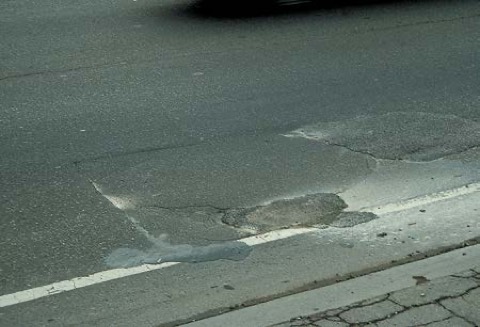
Down to the subgrade or an intact base layer.
The asphalt surface only, not the base.
Milling removes damage from the surface.
Patches wear out faster than the pavement around them.
Cracks
Cracks that still move. Special sealant over and in the crack keeps water and grit out.
Cracks that no longer move. Ordinary filler in the crack.
- Spring or fall, 45–64°F. Nothing wet in the crack.
- Consider sealing at about ¼ in. wide. Clean out debris first.
- Too late once cracking is dense and broken up.
Surface treatments
Repairs fix one spot. Thin coats cover a whole surface.
Surface treatments are thin coats on old pavement. They range from a light spray of diluted emulsion (fog seal) to one-size stone in binder (chip seal).
Upkeep over time
Seal coats
One more coat for finished asphalt.
Sealcoat is a black liquid coat on top of asphalt: on lots, driveways and playgrounds. Most is coal tar or asphalt emulsion.
One maker says its sealcoat replaces binder lost to weathering. Makers say reapply every 2 to 4 years.
Sealcoat steps
Coal tar is banned
| Sale | No pavement product containing coal tar. |
| Use | No product labeled coal tar on a driveway or parking area. |
| Coal tar | Over 10,000 mg/kg of PAHs, polycyclic aromatic hydrocarbons. |
| Pavement product | Includes sealcoat. |
Why
- Coal tar is a known human carcinogen.
- Worn particles travel on rain, wind, tires and feet, into homes. House dust near coal-tar lots: 25 times the PAHs.
- Runoff is acutely toxic to aquatic life, long after the 24–48 hour cure.
- Austin banned it in 2006. Lake sediment PAHs fell 58% from their peak.
- Asphalt-based sealers: typically about 50 ppm total PAH.
Before sealing
Check yourself
Binder and mixes
So far binder has been one glue. It comes in grades.
Binder is sold by performance grade (PG): the hottest and coldest pavement temperatures it is made for, in °C.
A letter for traffic level can sit between them. New York sets the grade in each contract.
New York grades
| PG 64E-22 | Polymer binder, downstate |
| PG 64V-22 | Polymer binder, upstate |
| No polymer | Driveways, curbs, sidewalks, bike paths |
| Per contract | The grade is set by a Special Note in the contract documents |
NYC mixes
| Type 3 RA | Binder course. RA: rut avoidance. |
| Type 6F RA | Top course |
| 30% RAP | Minimum recycled asphalt in each course, Local Law 71 of 2011 |
| 350°F | Maximum at the plant |
Hot mix and warm mix
Made above 300°F.
Additives or foaming make the binder runnier, so it coats the stone cooler. NYSDOT: 295°F max. leaving the truck.
Thickness
Mix size set each lift. These NYC sections add the layers up.
These are NYC DOT standards. No public NYC Parks path or park-road thickness schedule was found. The contract specifications govern each project.
Other NYC thicknesses
| Wearing course | Top course plus binder course: 1½, 2 or 3 in. |
| Leveling lift | 2 in. max |
NYC asphalt path
- Rolled with a tandem steel-wheeled roller.
- Within ¼ in. under a 10 ft straightedge.
- Mowing strip: same build, 2½ in. of asphalt.
Subbase rules
- Up to 10% fines are allowed, so subbase counts as impermeable, not free draining.
- Type 1 layers at least 6 in. In tight spots, no layer over 6 in.
- Top within ¼ in. of grade.
- Re-compact if frost disturbs it before paving.
Porous asphalt
Dense asphalt keeps water out. Porous asphalt lets it in on purpose.
Porous asphalt is open-graded: no fines fill the gaps between stones. Rain soaks through instead of running off.
Below it goes a crushed stone reservoir course that lets the water pass on down.
| Best for | Light duty: bike lanes, sidewalks, tree planting areas. |
| Light duty | One top course, 2½ to 4 in. |
| Under traffic | Porous top and base course, 9 in. combined at most. Porous asphalt with fibers may be used. |
| Below | Crushed stone reservoir course. Never 304 subbase, the standard NYSDOT Section 304 stone: it counts as impermeable. |
| Upkeep | Vacuum sweeping or pressure washing, regularly. |
| Limits | Upkeep costs, less load capacity, damage from turning wheels, clogging where there is debris. |
Color coatings
Sealcoat is black. Courts and some paths get color instead.
Acrylic coatings are water-based emulsions made for coating asphalt. On a court, resurfacer goes first: it cuts surface porosity so the color goes on even.
Court and play surface layers
Court steps
Cure time
Flood test
- Flood new asphalt before any coating. Fixing it after costs more.
- Patch material fills only about ½ in., and it can shrink so water ponds again.
- Birdbaths cause staining and peeling. Acrylic breaks down under standing water.
Court details
Color coatings gave the coats. Courts need the right surface under them.
Acrylic color goes on the asphalt as it is. Low spots hold water and can stain or peel the coat. Repaired cracks come back.
Coverage rates, per product
| Coat | Gallons per sq. yd. |
|---|---|
| Resurfacer, California Sports Surfaces | 0.05–0.07 per coat |
| Resurfacer, SportMaster | 0.07–0.09 per coat |
| Cushion base coat | 0.22 per coat |
| Cushion coats (3) | 0.10–0.11 per coat |
| Color, California Sports Surfaces | 0.10 or more total, 2+ coats |
| Color, SportMaster | 0.05–0.07 per coat |
| Line paint | About 1 gal per tennis court |
Weather
50°F and rising, no rain, surface under 140°F. SportMaster: above 50°F for 24 hours after.
Coats should dry fully the same day. All three coatings side by side: Weather.
Cracks
- Cracking in asphalt courts is inevitable. Repaired cracks come back.
- Four repair methods: crack filler, infrared patching, fabric systems, full-depth repair.
- SportMaster LevelMaster, an asphalt-emulsion resurfacer, is not for courts that freeze.
New courts
- Can be slippery at first. Soap bubbles after the first rains are normal.
- Color should look uniform from 25 ft.
- Shade from overhanging trees invites algae and mold.
- Resurface every 4–8 years, per one maker.
Paths and plazas
| Acrylic on asphalt | Walkways and cart paths. ColorPave: 0.13–0.15 gallons per square yard per coat, 2 coats. |
| Textured acrylic | Walkways and plazas, non-skid. |
| NYC DOT color | MMA (methyl methacrylate) or epoxy gravel. Green bike lanes, red bus lanes, truffle (a brown shade) for plazas. |
| Grip | NYC DOT: calcined bauxite or corundum, over 60 BPN on the ASTM E303 British Pendulum friction test. |
| Removal | MMA and epoxy are hard to remove without resurfacing. |
Concrete vs. asphalt
Courts can also be concrete. Wet ground treats the two very differently.
What each needs
A vapor barrier under the slab and drains around it.
Etch or shotblast the surface. No curing compound.
Cure 14–30 days first.
Clean it, patch low spots, fill cracks.
Vapor barrier
- Polyethylene film, 10 mil minimum, per one industry guide.
- SportMaster: two 6 mil sheets, laid in opposite directions, overlapped and taped.
- On a smooth base, sealed at seams, edges and anything poking through.
The binder close-up is in Inside asphalt.
Asphalt has holes too
- Packed asphalt still has small air pockets: about 5% at 95% density.
- The stones around them are coated in binder, which is waterproof. In concrete, moisture travels through capillaries.
- Loosely packed spots, like poor joints, let water in and wear out faster.
- Porous asphalt is open on purpose so water soaks through. See Porous asphalt.
Grip on concrete
- Acrylic bonds mechanically, so the concrete surface needs some porosity.
- Powder left on the slab: the coating sticks to dust, not concrete. Rub with a finger to check.
Concrete court steps
Tree roots
Root heave was one of the failure cards. Here is how it happens and how to stop it.
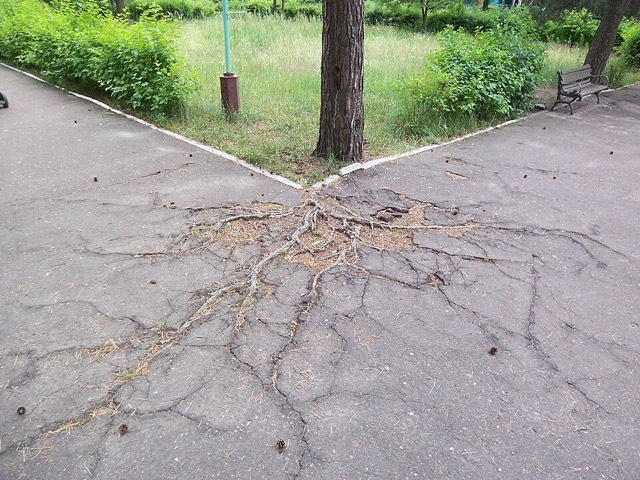
High risk
- Large or fast-growing species.
- Small soil volumes, shallow topsoil.
- Thin or no base under the paving.
- Irrigation can make it worse.
Asphalt sidewalks had more root conflicts than concrete ones.
Prevention
- Well-graded gravel base, compacted to standard: roots did not get through.
- Root barriers delay conflicts. Leave the top edge at least 1 in. above soil or mulch.
Weather
Hot asphalt, acrylic color and sealcoat each have their own weather limits.
Spec checklist
Every layer and coat is covered now. Here they are by use, then as a checklist.
Builds by use
Checklist
Check yourself
Glossary
Quiz
Flashcards
Questions
Sources
Each § mark opens a quote checked word for word against the source, with a link to it.
Not found
- A public NYC Parks asphalt, sealer or court-coating specification
- Sourced prevention for stripping and reflective cracking
- Thickness tables for parking lots and park roads